writings
- Writing Features | Sample Image Gallery | Social Media Announcements
Summer & Caribbean Rhythms: A Short Feature on a Young Dancer Stirring Louisville’s Dance Culture
Freelance | 2016.
It all started on a typical summer night, the summer after high school. Josh walked into Sky-Bar for their weekly live-band salsa on a Thursday night. As he looked at his feet and then onto the dance floor, he thought to himself, “I have to learn how to move like that.” What began as a typical Thursday transformed into a routine, and the routine evolved into much more than a hobby. Since then, Josh Gonzalez, now 24, has swayed through Caribbean-inspired rhythms across Louisville and the US.
There was a distinct energy and expression on everyone’s face: joy. One step after another, it was hard to balance the juxtapositions happening around him—moving feet, body, and mind. But that was it; he was hooked. Thursday nights became a sanctuary, and he began pushing boundaries in his dancing. Three weeks later, he encountered his long-term dance partner, and just a few months later, he performed for the first time. “I still remember my first performance; I was nervous like I’ve never been before,” said Josh, laughing as he reminisced about his first public performance at church in Louisville. “It was bad.” Though his performance marked an accolade for his dance takeoff, he says it’s good to look back and see the transformation.
Empezando
Gonzales believes an epiphany he had during the summer of his sophomore year spurred his journey into dancing. He attended Oldham County High School, a school with a low number of Latinos. “I attended the Latino Leadership and College Experience Camp in Lexington, Kentucky, where I related to all the Latinos who were my age. I learned a lot about my roots and that I should always feel proud of them.” Prior to this, the only connections to his roots were his parents, who have resided in Kentucky for over 25 years. The longing to connect with more Latinos brought him to work at a Mexican restaurant in La Grange after his graduation. There, he connected with two of his co-workers who danced to unwind after long work nights. He saw them fluently translate the music into dancing in the energy-filled bar. He had never danced before, but the aspiration to sway the way his co-workers swayed left him with perseverance. He booked lessons at Dance Louisville to fully learn the foundation step. It wasn’t easy, but once he grasped it, he began doing his own research and learning through YouTube while persistently dancing every Thursday. One year later, he began traveling to different conferences and dance events, inspired and taught by professional Bachata and/or Salsa dancers.
City after city, he began to realize that coming back to Louisville was especially hard when Latin dancing spots were limited. “In bigger cities, there’s a [dance] scene and resources like university dance clubs,” he said, talking about cities such as Chicago, Cincinnati, New York, and Florida. “There’s nothing like that here, and I think it’s awesome to be able to introduce that to Louisville.” His most recent performances have been at the Rocket City Latin Festival in Alabama with his team and at Tampa’s International Dance Conference, where he once stood as an attendee. “It was really a dream come true because the first dance event I ever attended was in Tampa, and I remember watching people on stage performing. While I watched, all I could think was how incredible they were, and think: everyone’s so good!” he said. “Standing on that stage and performing was kind of unbelievable; being able to give all that hard work and dedication to pay off like that.”
Más que un pasatiempo
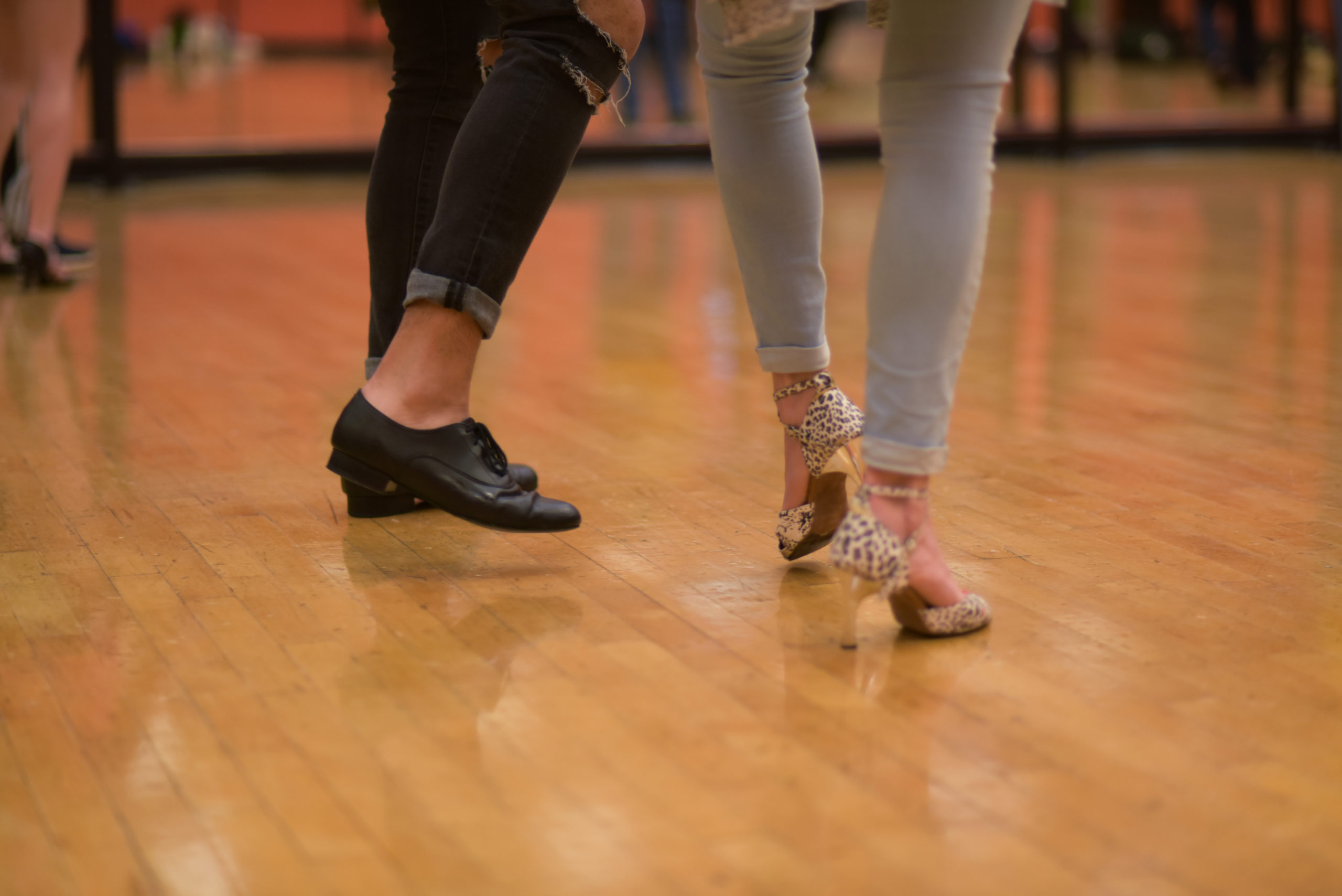
“Let’s watch, from the top! One, two, three— five, six, seven,” Josh told his class. Alongside Chelsey Owen, his current dance partner and co-instructor danced to La Murga, and their students stood in parallel lines behind them. “Step one, bring her back–two, three, and I am to immediately ask for her hand,” he continued. The sleek wooden floors reflect the fifty-fifty juxtaposition between Chelsey and Josh. “We separate the lead and the follow, which we both know but we separate those when we teach… It’s very collaborative,” said Chelsey, who has been part of the salsa scene for a few years and has known Josh for about three. Their dance collaboration fruition in 2016. Like Josh, they both believe that the salsa scene in Louisville is very important. “Culturally, it’s so vibrant and important. I think that it signifies community and friendship,” she said. “It brings people together. Five years later, Josh still attends Sky bar for salsa Thursdays, and in winter 2016, he was approached by Latin Louisville’s owner, who proposed the idea of him teaching a class at the Louisville Athletic Club (who partners with them.) He always knew he had been persistently focused on improving and learning, kind of like a gym enthusiast takes the gym seriously. Yet, he made it clear that this was more than a hobby. Josh now teaches every Monday for beginners and every Wednesday for intermediate dancers along with Chelsey Owens. “I believe everyone can dance,” he said, “it’s just wanting to learn,” he says. Coming from learning dance with no experience, this is something he is mindful of during his classes and teaching style.
Bailando, Louisville!
Alongside Latin Louisville, Josh hopes to help grow interest and support from the community. They have organized events such as Salsa in the Gallery, at the River House, Dance cruise, on the Belle of Louisville, and others. For additional salsa and bachata events, you may visit: https://www.facebook.com/latinlouisville. “Even though it’s not directly in my culture, there is something we commonly share in the music. [I think] It’s important and beautiful to have these connections,” Josh concluded. To learn more about the Latino Leadership and College Experience Camp, visit http://www.thellcec.org.

Sugar Baby
Freelance, 2014 | Aberrance Quarterly Magazine
Discretion is advised.
In the process of Deferred Action for Childhood Arrivals, an undocumented immigrant shares her story as she makes the choice to become a local sex worker.
As the sun began to rise, Adriana could feel herself sinking back into her bed. There, she had no need for makeup, no need for heels or any form of flattering clothes. Her outfit of the day: a plain t-shirt, sweatpants and a hoodie, but most importantly — no makeup. It was a relief in comparison to her work uniform: coated with mascara and dressed in lingerie.
“I offer massages with a happy ending,” she said; however, it didn’t start with a very happy beginning.
Adriana entered the U.S. by plane from Central America, at 18 months. Her visa expired when she turned 5 years old. She grew up like any other precocious child in a nation that prides itself on liberty and justice for all. Oblivious to her lack of citizenship, Adriana had no idea that this foreign land would be her home for the rest of her life. She is now 22.
She learned that she was an undocumented immigrant of the United States at the age of 12, when her older sister was 15 and wanted to learn to drive. Her parents explained to both of them what was going on.
She first came to the realization of what being undocumented meant at the age of twelve.
Her older sibling was fifteen and wanted—as an average American teenager should—to receive her driving permit. Her parents were forced to explain their situation. “I kind of already knew, but I didn’t really understand what it meant to be undocumented,” she said.
“I kind of already knew, but I didn’t really understand what it meant to be undocumented,” she said. Being undocumented meant she had no Social Security number or legal documents that would allow her to receive a Kentucky Driver’s License.
Adriana felt discouraged at the thought of her future. She knew that she had no opportunity at one of the first steps in adulthood without being eligible for a driver’s license. Bereft of the legal rights citizens are born with, Adriana could only hope that immigration reform would one day give her the kind of equality that was not just feel-good, but the kind that mattered: legal equality.
“When I was in high school the DREAM Act was big, but not as big as it has gotten,” she said. “It didn’t feel like change was coming,.”
According to the DREAM Act Info, over three million students graduate from U.S. high schools every year. Most get the opportunity to test their dreams and live their American story. However, a group of approximately 65,000 youth do not get this opportunity; they are smeared with an inherited title: an illegal immigrant.
Hence, the S.729 – Development, Relief, and Education for Alien Minors Act, or DREAM Act. It would allow those who entered the U.S. before the age of 15 and are currently enrolled in high school or have received a high school diploma to eventually receive residency of the U.S., as well as allowing those who qualify to receive financial support to continue their studies. It has yet to pass.
After high school, Adriana felt there was nothing she could do for her future. It felt as if movements like the DREAM Act were happening, “everywhere but here,” she said.
Personal problems arose for Adriana. Trying to overcome them, she joined a few movements, one of them being Occupy. In retrospect, she thought outloud, “when I was 12 years old, I thought PETA was the greatest thing I could do for the world. Slowly I figured out there were much bigger issues and I just had to get out there and fight somehow.”
This was also the beginning of a new job opportunity for Adriana; becoming a local sex worker. She offered sexual favors to those who set up appointments through an office or e-mails. Aware that others were forced into the field because of drugs or in danger of body trafficking, Adriana employed herself in the sex industry with different motivations. She was intrigued, she said, after first being introduced to the sex industry through friends who worked as strippers, escorts, or had their own webcam shows. There, she found her way into an escort website.
“I enjoy this job,” Adriana said. “I’m not going to say that everything is great. The money is good, I have flexible hours that’s going to allow me to go and pay for school…but there’s still the bad, emotional side.”
The not-so-great side revealed itself in other situations where clients pulled her hair or pushed her body in an effort to manipulate her service. According to a study “Mortality in a Long-term Open Cohort of Prostitute Women,” 204 in 100,000 prostitutes die every year. Even though she hadn’t been in a situation where someone was dangerously aggressive, one client had left her without a penny of compensation after she provided her services.
“That’s probably one of the worst feelings in the world — having someone use your body when you would have never let them do that if you would have known that they wouldn’t pay and would just walk away,” she said. “That’s not just theft, that’s, I don’t know, that’s the emotional side.”
As a curvy Latina, she felt at a disadvantage. White, blonde, and skinny was thought to be the perfect girl, she said.
Although statistics do not say anything about preference, they show that more than 50% of sex workers are minorities and 85% of them are sentenced in jail according to Casting Stones: Prostitution and Liberation in Asia and the United States.
Despite her insecurities, she stood proud aside other curvy women who want sex work to become less taboo.
“This is a real job. It just happens to involve sex,” she said. “This is going to feed my family. I don’t want to be seen as a victim.”
For her, it came down to a theory.
“You build your business, and your business is your body, your face, your attitude, and your personality,” Adriana said.
After working in the sex industry for a year, Adriana found herself at ease with her sexuality. She found out that just because she liked makeup, didn’t mean she wanted to use it on her off days. She found herself a different *Adriana from a year prior.
“At the beginning I was almost too shy to tell them ‘no’ and I would let them be forceful,” she said. “I’ve come to the point in where I’m comfortable, and come to realize I am in control of this situation. I can tell you no, and I can tell you to leave. I don’t do anything ‘extra’,”
She found her own voice.
She continued to live in reality, though. It was familiar place where her body was a commodity for male consumption, her existence undocumented, and well-being unprotected. She remained a woman working among women to support a family that depended on the strength of her will; a woman with the courage to face necessity with dignity and an alluring smile.
She is currently in the process of applying for Deferred Action for Childhood Arrivals (DACA), a grant that allows those who have entered the country as children to receive work authorization as well as social security number. This allows them to legally work in the US. However, because of lack of documentation, Adriana has yet to send her complete application. She has plans on enrolling into a local college and pursuing a career in law or social work.
*Adriana’s name has been changed for privacy concerns
GALLERY: Obama rallies Ohio voters
Social Media Writing
Highlights | Kentucky Career Center Louisville
Caption:
Last year, Gov. Andy Beshear joined Shelby County Juneteenth celebration and signed a proclamation recognizing Juneteenth in Kentucky at our Health & Wellness & Job Fair in collaboration with Clay Street Baptist and NAACP. This year, the celebration continues and the Health and Job Fair will be held at the Shelbyville Conference Center (219 7th St.) between 10 AM to 4 PM on Friday, June 16.
Scroll to page 5 to see some of the featured employer’s!
Last year’s proclamation, highlighted the importance of Juneteenth and honoring the legacy of emancipation, and promoting unity, equality, and social justice for all. We hope to see you there to kick off Juneteenth 2023!
#job #health #collaboration #wellness #kyhiring